Doroni H1-X Flying Car: Price, Specs, License Requirements & Release Date — Complete 2026 Guide
eVTOL · Urban Air Mobility · Personal Aviation

What Is Doroni Aerospace?
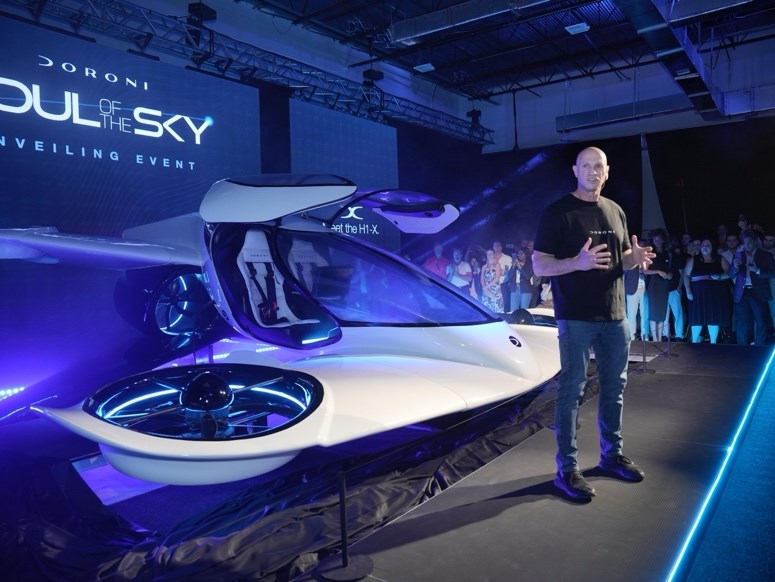
Doroni Aerospace is a personal electric vertical takeoff and landing (eVTOL) aircraft company based in Pompano Beach, Florida. Rather than building air taxis or ride-sharing platforms, the company is doing something far more audacious: creating a flying vehicle that ordinary individuals can own, park in their own garage, and pilot themselves much like a car, only through the sky.
The company's origin story is remarkably human. In 2016, founder Doron Merdinger began sketching out his idea using nothing more than a 3D printer and a rented garage space. His central question was simple but profound: "The technology is already here. Why are we still stuck on the ground?" That question became the founding premise of Doroni Aerospace.
Today the company holds an FAA Special Airworthiness Certificate for its H1 prototype, has completed over 70 test flights, and maintains partnerships with Space Florida, Honeywell, and Garmin. In February 2025, it attracted a landmark $30 million strategic investment from Saudi Arabia-based Innovation Wings Industries (IWI).
"Why limit the future? Allow everyone consumers, businesses, and governments to buy these aircraft."— Doron Merdinger, Founder & CEO
Who Is Doron Merdinger?

Doron Merdinger is a serial entrepreneur who studied microelectronics and computer science before earning a BBA at USIU and an MBA at the NYU Stern School of Business. Prior to founding Doroni, he served as CEO of Hazorfim, a storied Israeli silversmith brand, where he doubled the company's revenue through technology-driven innovation.
His decision to start Doroni was shaped in part by a deeply personal experience. After exiting his first company, Merdinger went through what he describes as a near-death experience one that crystallized his belief that true freedom of movement is one of the most fundamental things a person can have. From that moment, he devoted himself entirely to creating a vehicle that would give people the freedom to fly.
He personally invested $250,000 to build the first two prototypes and invited his chief electrical engineer to live at his home for six months while they assembled the first H1-X together. His build-in-public leadership style sharing triumphs and setbacks with equal candor has earned him a loyal following among investors and aviation enthusiasts alike.
What Kind of Company Does He Want to Build?
While most eVTOL companies Joby Aviation, Archer, Lilium are building large aircraft intended for operator-run air taxi networks and urban vertiport infrastructure, Doroni is carving out an entirely different market: flown by their owners, stored at home, and used like an everyday vehicle.
This is not a subtle distinction. It means Doroni's customers are not municipalities or airline operators they are individuals who want to commute by air from their own driveway. Every design decision, from garage-compatible dimensions to the 20-hour pilot training program, flows directly from this single vision.

Over the long term, Doroni plans to expand the H1-X platform into a full family of aircraft: a four-seat family model, cargo variants, emergency medical service (EMS) aircraft, and military reconnaissance platforms. The company's proprietary AI operating system, SOUL.AI, is being developed as the common backbone across all future models.
The February 2025 investment deal with Innovation Wings Industries includes a joint venture to manufacture H1-X aircraft in Saudi Arabia from 2027, with global distribution rights — signaling that Doroni's ambitions are firmly international.
"We envision a future where commuting takes minutes, not hours and that future is being built right now."
Can You Really Fly It With a Driver's License?
One of Doroni's most radical propositions is the near-elimination of the barrier to entry for flying. Commercially certified pilots must accumulate a minimum of 1,500 flight hours. The H1-X requires roughly one-sixtieth of that a weekend's worth of training.
In July 2025, the FAA finalized the MOSAIC (Modernization of Special Airworthiness Certification) rule. This landmark regulation formally expands the Light Sport Aircraft category to encompass electric propulsion and powered-lift vehicles like the H1-X, removes outdated weight restrictions, and simplifies the pilot certification pathway.
Under the finalized MOSAIC rule, Sport Pilots no longer need an FAA medical certificate and may operate aircraft under expanded conditions including night flying. CEO Merdinger has stated his goal is for the certification process to be completable "in a single weekend" for most candidates.
The Doroni H1-X: Specifications & Performance
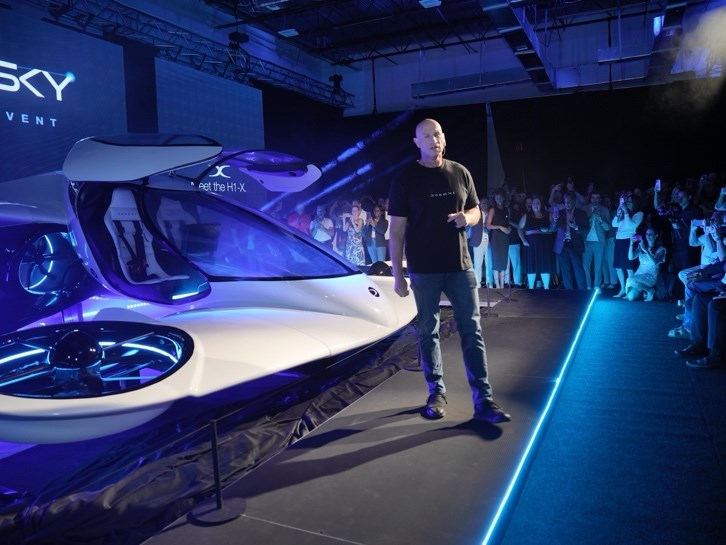
The H1-X is the second-generation Doroni aircraft, rebuilt from the ground up after lessons learned from the original H1 prototype. It features a tandem (fore-and-aft dual) wing configuration combined with enclosed electric ducted fans and a carbon-fiber airframe. Doroni holds five issued U.S. patents on this combination.
Propulsion Architecture
Four electric ducted fans embedded within the tandem wings provide vertical lift during takeoff and landing. Each fan is driven by two counter-rotating coaxial motors eight independent electric motors in total delivering exceptional fault tolerance. Once airborne, two rear-mounted pusher propellers take over forward thrust while the wings generate lift, dramatically reducing battery consumption and extending range.
Safety Systems
The multi-motor distributed architecture means that even if several motors lose power, the remaining units maintain stable flight. This is augmented by a multi-layer collision avoidance system incorporating LiDAR, optic-flow cameras, barometers, and accelerometers. For worst-case scenarios, a full-aircraft ballistic parachute is standard. The SOUL.AI Digital Copilot™ provides real-time airspace management, voice-command interaction, and continuous self-diagnostic monitoring.
Everyday Convenience
At approximately 16 ft long, 18 ft in wingspan, and 6.2 ft tall, the H1-X fits a standard two-car garage. It rolls in and out on landing gear wheels, just like parking a car. The battery is compatible with home EV chargers, and packs are swappable for back-to-back flights with minimal downtime.
The Strengths and Limitations of the H1-X
Strengths
Limitations & Risks
The Road Ahead: What Still Needs to Be Solved
Commercial sales cannot begin without full LSA type certification under MOSAIC. As the first vehicle of its kind, there are no direct precedents to expedite the process.
NASA and the FAA are still developing the Urban Air Traffic Management (UTM) framework for low-altitude urban airspace. Personal eVTOLs cannot operate safely at scale without it.
A 45-minute flight window is practical for today, but becoming a genuine daily commuter vehicle will require next-generation battery technology to meaningfully extend range.
Moving from small-batch prototypes to seven units per day requires a complete manufacturing build-out and a robust global supply chain.
Markets outside the US Europe, Asia, the Middle East each have separate aviation authorities and standards. Each market entry requires its own regulatory campaign.
At $400,000 the H1-X is a luxury product. True mass adoption requires the cost curve to descend dramatically driven by scale, battery cost reductions, and manufacturing efficiency.
When Can You Realistically Expect to Fly One?
Based on Doroni's publicly stated roadmap and independent industry analysis, the most likely trajectory for commercialization looks like this:
A note of caution is warranted. Certification delays are endemic to the eVTOL industry. Independent analysts generally place the window for consumer-accessible personal eVTOLs in the United States at 2027 to 2030, with genuine mass-market adoption more likely in the mid-2030s.
The Vision Driving Doroni Aerospace
Doroni Aerospace's vision is not simply to sell an expensive flying car to a handful of wealthy early adopters. At its core, the company is pursuing the a future in which personal air travel is as routine and accessible as driving a car.
The company envisions a world where urban commuters bypass gridlock entirely by ascending vertically from their own driveways, traveling to their destination in minutes rather than hours, and landing on a colleague's parking pad or rooftop. Every design decision flows directly from this single animating idea.
Doroni views the entire Urban Air Mobility market as a potential $1 trillion opportunity, and believes the personal ownership segment currently almost entirely unaddressed represents the highest-value, most defensible position within it. Where competitors are building transit infrastructure, Doroni is building personal freedom.
Looking further ahead, the SOUL.AI platform is being positioned as the intelligent backbone for an entire ecosystem: autonomous flight modes, integrated airspace coordination, self-diagnostics, and eventually fleet management for emergency services, cargo logistics, and defense applications.
"People are frustrated by traffic jams, pollution, and the destruction of the ecosystem. Why destroy nature and create congestion in our urban spaces if you have the technology to circumvent these problems?"— Doron Merdinger, CEO & Founder
What Else You Should Know
The Investor Perspective
Doroni is currently raising funds through a public crowdfunding campaign on StartEngine (Reg CF) alongside institutional investment. The company's pre-money implied valuation stands at approximately $226 million. Total cumulative funding raised has reached approximately $28.5 million across three rounds. The 600+ pre-order pipeline represents a potential $175 million in revenue, though delivery timing and final pricing remain subject to development progress.
Competitive Landscape
In the personal eVTOL ownership space, Doroni's closest comparable is Sweden's Jetson Aero. In the broader eVTOL ecosystem, EHang, Volocopter, and BETA Technologies are often cited as competitors, though all three pursue fundamentally different market models operator-run commercial services rather than individual ownership. Doroni's garage-compatible, owner-operated model remains essentially unique in the global landscape.
What the Market Research Says
McKinsey estimates the Urban Air Mobility market will reach $35 billion by 2035. Global eVTOL investment exceeded $8 billion in 2025. The personal ownership segment commands substantially higher per-unit margins and faces fewer infrastructure dependencies — making it an attractive niche for a focused startup with the right product.
A Note on International Markets
For the H1-X to operate outside the United States, Doroni will need separate type certifications from local aviation authorities the European Union Aviation Safety Agency (EASA) in Europe, and equivalent bodies in Asia and the Middle East. The Saudi joint venture with IWI is strategically positioned to serve as both a manufacturing hub and a gateway to international markets, leveraging Saudi Arabia's Vision 2030 aviation expansion program.

댓글
댓글 쓰기